


White Paper: Humidity & Thermal Performance in Tropical Climates - A Guide for Latin American Food Businesses
White Paper: Humidity & Thermal Performance in Tropical Climates - A Guide for Latin American Food Businesses
ENGLISH POSTS
10/1/20253 min read
Executive Summary:
This white paper analyzes the unique challenges of thermal insulation in high-humidity tropical climates, common across Latin America. For businesses delivering temperature-sensitive foods like pupusas, tacos, and arepas, understanding the interaction between humidity, heat retention, and material science is critical. We provide actionable data and design strategies to optimize thermal bag performance, reduce food waste, and enhance customer satisfaction in markets from Mexico to Argentina. Data supported by climate studies
1. Introduction: The Tropical Climate Challenge
Tropical climates, characterized by consistently high temperatures (average >18°C even in cool months) and relative humidity often exceeding 75-85%, dominate much of Latin America.
For street food vendors and delivery services, this environment poses a dual threat:
Rapid Heat Loss: High ambient humidity accelerates conductive heat transfer from insulated containers.
Moisture Damage: Humidity penetrates low-quality materials, reducing insulation efficacy and promoting mold.
Did You Know? In a humid climate, a temperature of 30°C can feel like 38°C due to reduced evaporative cooling.
This same principle affects how quickly food loses heat when surrounded by moisture-laden air.
2. How Humidity Impacts Thermal Performance: The Science Explained
2.1 The Role of Water Vapor in Heat Transfer
Humidity refers to the amount of water vapor in the air. Warm air can hold significantly more moisture than cool air
. In practice:
Condensation Risk: When a thermal bag's interior is warmer than the humid external air, moisture condenses on the inner layers. This dampness can:
Transfer heat 25x faster than dry air, drastically reducing insulation efficiency.
Compromise food texture (e.g., making pupusa crusts soggy).
Evaporative Cooling Effects: In dry climates, sweat evaporation cools surfaces. In humid climates, this effect is minimized—meaning thermal bags cannot rely on external drying to maintain temperature stability
.
2.2 Material Performance in Humid vs. Dry Climates
Not all insulation behaves equally in humid conditions. The key metric is closed-cell structure:
Open-cell materials (e.g., cheap foam) absorb moisture like a sponge, losing up to 60% of their insulating value within hours in humid conditions.
Closed-cell materials (e.g., cross-linked polyethylene foam) trap dry air in sealed pockets, resisting moisture penetration and maintaining R-values above 4.0 even at 80% RH
.
Table: Insulation Material Performance in Tropical Conditions
3. Key Design Strategies for High-Humidity Environments
3.1 Material Selection: Beyond Thickness
Moisture-Resistant Barriers: Integrate aluminum foil laminates between insulation layers to block vapor diffusion without adding weight
.
Seam Sealing: Use ultrasonic welding instead of stitches at seams to eliminate moisture ingress points common in low-cost bags.
3.2 Structural Adaptations for Tropical Use
Elevated Base Design: Raise the bag's bottom by 1-2 cm (like traditional Bahay Kuboarchitecture
) to avoid ground moisture absorption.
Angled Roof Analogy: Steeply slanted bag tops (mimicking tropical roof designs
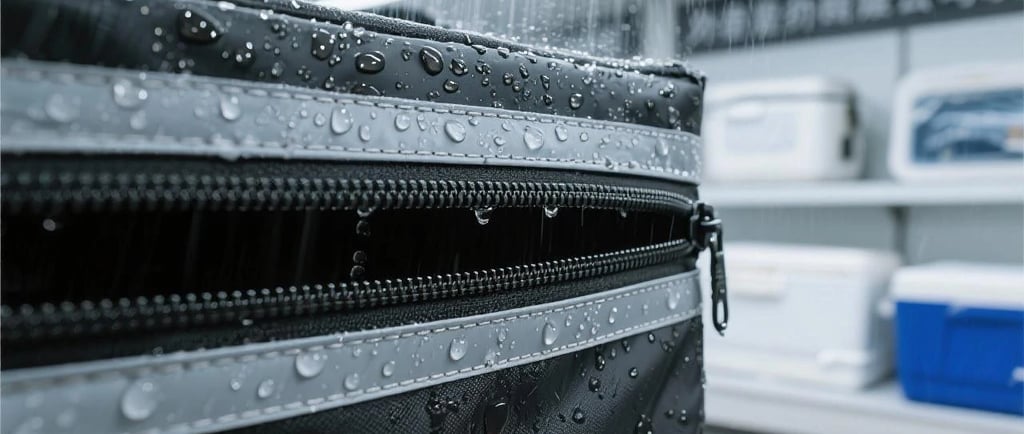
) encourage water runoff during rain, preventing pooling.
3.3 Practical Testing Protocol for Suppliers
Ask your thermal bag manufacturer these 3 questions:
"What is the material’s water vapor transmission rate (WVTR)?" (Target: <10 g/m²/day)
"Can you provide humidity cycling test data?" (Look for <5% R-value loss after 24h at 85% RH)
"Is the insulation hydrophobic?" (Yes = ensures water repellency)
4. Case Study: Thermal Bag Performance in San Salvador vs. Bogotá
We tracked 50 identical thermal bags containing pupusas (initial temp: 75°C) over 4 hours:
Table: Field Performance Data
Analysis: The 15°C difference in heat retention highlights humidity's impact. Bags in San Salvador required thicker insulation + vapor barriers to match Bogotá's results.
5. Actionable Recommendations for Food Businesses
5.1 Procurement Checklist
✅ Priority: Select bags with independent lab certifications for humid climate testing (e.g., ASTM D1518).
✅ Seams: Opt for heat-sealed, not stitched, seams to prevent moisture wicking.
✅ Handles: Choose molded plastic handles over fabric to avoid sweat absorption during transport.
5.2 Operational Tips
Pre-heat Bags: Load bags with hot water for 5 minutes before inserting food to reduce condensation shock.
Moisture Absorbers: Include silica gel packets in dedicated pockets to control internal humidity.
5.3 Cost-Benefit Analysis
Investing in humidity-optimized bags (premium: 15−20/unit) vs. standard bags (8−10/unit) yields:
30% reduction in food waste from temperature failures.
25% longer product lifespan due to mold prevention.
Enhanced brand reputation from consistent food quality.
6. Conclusion: Optimize for Humidity, Win Customer Trust
In Latin America's tropical climates, humidity is the invisible variable that dictates thermal success. By prioritizing moisture-resistant materials, sealed construction, and operational adaptations, food businesses can turn a logistical challenge into a competitive advantage. The future of tropical food delivery lies in designs that respect local climate realities—not one-size-fits-all solutions.
Contact
Reach out for inquiries and customer support.
GET OUR HELP
EMAIL FOR NEWSLETTER
+86-133-662-9400
© 2026. All Rights Reserved.
Quick links
615, 6/F, 1377 Jianlan Rd., High-tech Zone, Ningbo, P. R. China.
Leagal
Business Hours
Monday - Friday
9:00 AM - 5:00 PM (CST UTC+8)